
For many subcontractors, this is where things get complicated. Bonding requirements are showing up more frequently, even on mid-sized private projects, and subs who haven't been through the process before often don't know where to start — or what they're actually agreeing to.
This article covers what a subcontractor performance bond is, when you need one, how to get bonded, what it costs, and what happens if something goes wrong on the job.
Key Takeaways
- A subcontractor performance bond is a three-party guarantee (you, the GC, and a surety) ensuring you complete your contracted scope.
- Performance bonds are legally required on most public projects above certain dollar thresholds — private projects vary by GC preference.
- Bond premiums are a percentage of the subcontract value, based on your financials, credit, and project size.
- Unlike insurance, a bond is not a safety net for you — if the surety pays a claim, you owe that money back.
- A specialist bond broker connects you with A-rated carriers across standard and specialty markets, speeding up approvals and improving your rates.
What Is a Subcontractor Performance Bond?
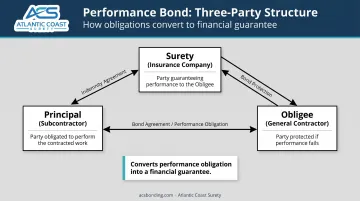
A subcontractor performance bond is a three-party agreement involving:
- The principal — the subcontractor obligated to perform the work
- The obligee — the general contractor requiring the bond
- The surety — the insurance company guaranteeing the sub's performance
If you fail to complete your contracted scope, the surety steps in to resolve the default by paying the GC's additional costs, financing your completion, or arranging a replacement sub. The bond converts your performance obligation into a financial guarantee the GC can rely on.
What the Bond Covers (and What It Doesn't)
A performance bond covers default due to financial failure, staffing problems, or inability to finish the work. Coverage has clear limits, though:
- Payment to lower-tier subs and suppliers is not covered — that's a payment bond's function
- Scope disputes or contract interpretation disagreements fall outside the bond entirely
- Your own financial exposure remains if a claim is paid out against you
That last point catches many subs off guard. A performance bond is not insurance that absorbs losses on your behalf. When the surety pays out on a claim, you are contractually obligated to reimburse every dollar through the General Agreement of Indemnity — a document you sign before the bond is issued.
According to NASBP, indemnitors typically include the principal, business owners, spouses, and often affiliated entities — meaning your personal assets can be on the line.
When Do Subcontractors Need a Performance Bond?
Public Projects: Federal and State Requirements
On federal construction projects, FAR 28.102-1 (as updated by FAC 2026-01, effective March 2026) requires performance and payment bonds on contracts exceeding the applicable FAR threshold. The technical obligation falls on the prime contractor, but GCs routinely flow bond requirements down to major subs — particularly those handling critical or high-value scopes.
State and local governments have their own versions, often called "Little Miller Acts." Thresholds vary significantly by jurisdiction:
| State | Public Project Bond Threshold |
|---|---|
| Texas | Performance bond required if contract exceeds the applicable state threshold |
| Florida | Exemptions apply below certain thresholds (verify current requirements) |
| North Carolina | Required when total construction contracts exceed the applicable state threshold |
| Virginia | Required on contracts exceeding the applicable state threshold |
Always verify requirements for your specific state and locality before bidding — rules vary too much to assume.
Private Projects
No universal federal or state law requires subcontractor performance bonds on private work. GCs can and do impose them at their discretion — particularly on high-value or specialized scopes where replacing a defaulting sub is costly. Review every subcontract carefully, since bond requirements aren't always spelled out at the bid stage.
Why GCs Require Subcontractor Performance Bonds
The primary reason is risk management. If a sub defaults mid-project — especially one handling mechanical, electrical, or structural work — the GC faces schedule delays, cost overruns, and potential liability to the project owner. A bond gives the GC a financial backstop.
GCs also use the surety's underwriting process as an informal prequalification screen. A surety company vets your finances, project history, and organizational capacity before issuing a bond — which means passing that process carries real weight. You've been evaluated by an independent third party and found creditworthy.
Data from SFAA's EY report reinforces why this matters: prequalification was used on 96% of bonded projects versus just 61% of non-bonded ones, and 97% of respondents said they'd pay more to use bonded contractors. Being bondable puts you in front of GCs who actively screen out unbonded subs before bids are even reviewed.
How to Get a Subcontractor Performance Bond
Start with a qualified surety broker or bond-only agency — one with access to multiple A-rated, Treasury-listed surety markets who can match you to the right program. If your financial profile is complex or you're bonding for the first time, a specialist with both standard and specialty market access (like Atlantic Coast Surety) will move your application through underwriting faster than a generalist agent.
The Bond Application Process
Expect to submit:
- CPA-prepared financial statements (current and prior years)
- Corporate tax returns (most recent year)
- Current personal financial statements
- Three months of corporate and personal bank statements
- Work-in-progress report (bonded and unbonded)
- List of completed projects and references
- Project-specific documents: copy of the subcontract, scope description, contract amount, start and completion dates
Accuracy matters. Underwriters look for inconsistencies in financials or unexplained gaps in project history. Get your records in order before applying — a sloppy submission delays approval and, in some cases, leads to avoidable declines.
What Underwriters Are Looking For: The 3 Cs
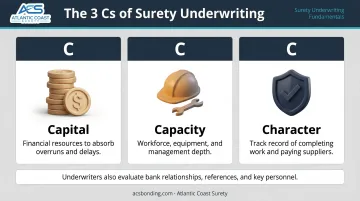
According to NASBP, surety underwriting centers on three core factors:
- Capital — Sufficient financial resources to absorb cost overruns, delays, or unexpected project costs
- Capacity — The workforce, equipment, and management depth to handle this project on top of existing commitments
- Character — A consistent track record of finishing work on time and paying subcontractors and suppliers
NASBP also notes that underwriting goes well beyond this shorthand — bank relationships, project references, key personnel resumes, and organizational structure all factor in.
What Does a Subcontractor Performance Bond Cost?
NASBP's bonding guides put the typical premium as a percentage of the total contract amount. Where you land in that range depends on:
- Your credit score and financial strength
- The size and complexity of the project
- Your bonding history and project track record
When bonding is a specified contract requirement, you can — and should — include the bond premium cost in your bid or payment application so it doesn't come out of your margin.
What Happens If a Subcontractor Defaults on a Performance Bond?
How a Claim Gets Filed
If the GC believes you can't or won't complete the work, they notify the surety and file a formal claim. The surety opens an investigation to determine whether a valid default has occurred — this isn't an automatic payout. The surety reviews the contract, your performance history on the project, and the circumstances leading to the alleged default.
The Surety's Options
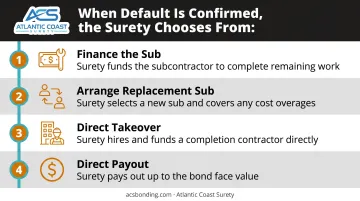
Once default is confirmed, the surety typically chooses from several remedies:
- Finance or support the sub to complete the remaining work
- Arrange for the GC to select a replacement sub, with the surety covering any additional costs up to the bond amount
- Take over the project directly and fund a completion contractor
- Pay out the bond amount (limited to the bond's face value)
Indemnity and Personal Liability
The surety pays the GC — then comes back to you for reimbursement. The General Agreement of Indemnity you signed before the bond was issued requires you to repay every dollar paid out, including legal and investigation costs. Personal liability is common. For the defaulting sub, a bond claim doesn't close the matter; it typically opens a lengthy and expensive recovery process.
If you sense a project is going sideways, don't wait for the GC to file a claim. Contact your surety broker and communicate with the GC early. Sureties can work with you on a resolution before a formal default is declared — options that disappear once the claim is filed.
Frequently Asked Questions
What is a subcontractor performance bond?
A subcontractor performance bond is a three-party agreement among the sub (principal), the GC (obligee), and a surety company, guaranteeing the sub will complete their contracted scope. If the sub defaults, the surety steps in to cover costs, then seeks reimbursement from the sub.
Do subcontractors need performance bonds?
It depends on the project. The Miller Act requires bonds on federal contracts above the applicable threshold, and most states have parallel Little Miller Act thresholds for public work. On private projects, no universal law applies, but GCs can require bonds at their discretion.
How do subcontractors get performance bonds?
Subs apply through a surety broker or bond-only agency, submit financial and project documents, go through underwriting (the 3 Cs evaluation), and pay a premium once approved. Working with a specialist broker shortens turnaround time and opens access to more competitive markets.
How much does a subcontractor performance bond cost?
Premiums are a percentage of the subcontract value, according to NASBP. Your credit score, financial strength, project size, and bonding history all affect where you fall in the available range. The cost can be included in your bid.
What happens if a subcontractor defaults on a performance bond?
The GC files a claim with the surety, which investigates and resolves the default by financing completion, sourcing a replacement sub, or making a direct payout. The defaulting sub must repay the surety for all costs under the indemnity agreement, often including personal liability.
What is the difference between a performance bond and a payment bond for subcontractors?
A performance bond protects the GC if the sub fails to complete the work. A payment bond (when held by the sub) protects the sub's own lower-tier subs and material suppliers if they aren't paid. They cover opposite directions of risk in the contract chain; on many public projects, both are required.