
Introduction
Federal construction contracts carry strict legal requirements, and the Miller Act bond ranks among the most consequential. Under 40 U.S.C. §§ 3131–3134, prime contractors on qualifying federal projects must secure both a performance bond and a payment bond before work begins. Miss this requirement, and you risk contract disqualification before a single shovel hits the ground.
This guide is written for three audiences:
- Contractors bidding on federal projects who need to know what's required and when
- Subcontractors and suppliers who want to understand their protections and how to preserve them
- Developers navigating public works compliance across jurisdictions
Subcontractors can't file mechanics liens on federal property. The payment bond is their only legal recovery path — which means knowing how it works, and how to protect your claim rights, directly affects whether you get paid.
Key Takeaways
- Miller Act bonds are required on federal construction contracts exceeding the applicable FAR threshold under FAR Part 28 (the statute's threshold is effectively superseded by FAR requirements)
- Two bonds are required: a performance bond (protects the government) and a payment bond (protects subs and suppliers)
- Second-tier subcontractors must send written notice to the prime contractor within 90 days of last furnishing
- All claims must be filed in federal district court within 1 year of last furnishing
- Bonds must be issued by a surety on the Treasury Department's Circular 570 (T-listed) approved list
What Is the Miller Act Bond?
The Miller Act bond is the umbrella term for two federally mandated surety instruments — a performance bond and a payment bond — required under 40 U.S.C. §§ 3131–3134. Congress enacted the Miller Act in 1935, replacing the earlier Heard Act of 1894.
Why the Law Exists
The core problem the Miller Act solves is a structural gap in federal construction law. On private projects, unpaid subcontractors and suppliers can file a mechanics lien against the property. On federal projects, that remedy doesn't exist — sovereign immunity prevents liens from attaching to government-owned property.
As the GSA explains: "Because Federal buildings are not subject to mechanic's liens," payment recourse is established through the Miller Act. The payment bond serves as the functional substitute — a private fund that claimants can pursue instead of the property itself.
Miller Act Bond vs. General Surety Bond
Unlike a commercial surety bond, a Miller Act bond is not a voluntary risk management tool. The federal government mandates both bonds as a condition of contract award, and neither can be waived by the contractor or contracting officer except in narrow statutory circumstances.
Key differences from standard commercial surety bonds:
- Trigger: Required by federal law on qualifying contracts, not by choice
- Scope: Applies exclusively to federal public works projects
- Waiver: Cannot be declined or negotiated away by either party
- Purpose: Replaces the mechanics lien remedy that federal sovereign immunity blocks
Federal Bonding Requirements: When the Law Applies
The Threshold: Statutory vs. FAR Requirements
The statute — 40 U.S.C. § 3131(b) — sets a base threshold, but FAR 28.102-1 (updated FAC 2026-01, effective March 13, 2026) requires performance and payment bonds on construction contracts exceeding the FAR threshold.
For procurement purposes, treat the FAR threshold as the operative requirement. The FAR governs how federal agencies actually award contracts, and contracting officers follow FAR — not the raw statutory text — when evaluating bid compliance.
The Mid-Range Band
Contractors working in contracts between the lower and upper FAR thresholds aren't off the hook. Current FAR 28.102-1(b) requires contracting officers to select alternative payment protections for contracts in that range. Acceptable alternatives include:
- Payment bond
- Irrevocable letter of credit
- Tripartite escrow agreement
- Certificates of deposit
- Other security acceptable to the contracting officer
The FAR clause governing this band is FAR 52.228-13.
Timing and Bond Amounts
Both bonds must be in place before contract award — not after work starts. Under 40 U.S.C. § 3131(b) and FAR 52.228-15, the bonds become binding when the contract is awarded.
On bond amounts:
- Performance bond: Generally set at the full original contract price unless the contracting officer makes a written determination that a lesser amount is adequate
- Payment bond: Also generally equal to the full contract value; per 40 U.S.C. § 3131(b)(2), the payment bond may not be less than the performance bond amount
T-Listed Surety Requirement
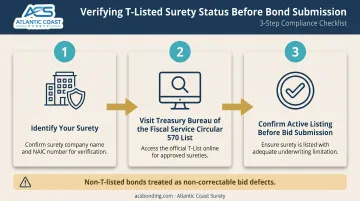
FAR 28.202 requires that corporate sureties on U.S.-performed federal contracts appear on the Treasury Department's Circular 570 list — commonly called the "T-list." The GAO has held bids nonresponsive where the surety was not listed in Circular 570, treating the defect as a non-correctable error, not a minor irregularity.
Always verify your surety's T-listed status before submitting a bond. The Circular 570 certified companies list is publicly available through the Treasury's Bureau of the Fiscal Service.
Waiver Provisions
Under 40 U.S.C. § 3134, certain agencies — the Secretaries of Army, Navy, Air Force, Transportation, and Commerce — may waive bonding requirements for specific contract types.
Covered situations include cost-plus-a-fixed-fee contracts, certain vessel and aircraft procurement, and work where furnishing a bond is impracticable. These exceptions are narrow and agency-specific, not general workarounds contractors can rely on.
State Equivalents: Little Miller Acts
All 50 states have enacted their own versions of the Miller Act, covering state and local government construction projects. Thresholds, notice deadlines, and claimant tiers vary considerably by state. If you're working on state or local public works projects, research the requirements for that specific jurisdiction — don't assume federal rules apply.
The Two Types of Miller Act Bonds Explained
Performance Bond
The performance bond protects the federal government if the prime contractor defaults. Per NASBP, when a contractor defaults, the surety has several options:
- Fund the original contractor to finish the work (finance completion)
- Select and pay a replacement contractor to complete the project
- Provide a direct financial remedy for excess completion costs
One detail that's frequently overlooked: under 40 U.S.C. § 3131(c), every performance bond must specifically cover federal taxes withheld or deducted from contractor wages. The government must notify the surety within 90 days after the contractor files a tax return, and no later than 180 days from when the return was due (including extensions).
Payment Bond
Where the performance bond protects the government, the payment bond protects subcontractors, laborers, and material suppliers. Because they cannot file mechanics liens against federal property, the payment bond is their only practical recovery mechanism.
Both bonds are required simultaneously and typically set at the full contract value. The payment bond amount cannot be less than the performance bond amount — this floor is fixed by statute, not underwriter discretion.
Who Is Protected and How Claims Work
Protected Tiers
Not every party on a federal project has Miller Act rights. The Supreme Court has addressed this directly:
| Party | Protection |
|---|---|
| Prime contractor's direct subs (first tier) | Protected under the payment bond |
| Subs to first-tier subs (second tier) | Protected, but must give written notice |
| Third tier and below | Not protected |
| Suppliers to the prime or first-tier subs | Protected |
| Suppliers to other suppliers | Not protected |
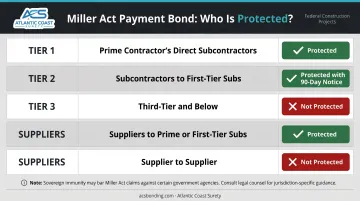
In Clifford F. MacEvoy Co. v. United States (1944), the Supreme Court held that a supplier to a materialman (a supplier of materials) is not covered. In J.W. Bateson Co. v. Board of Trustees (1978), the Court limited the definition of "subcontractor" to parties contracting directly with the prime.
The 90-Day Notice Requirement
Second-tier parties — those with no direct contract with the prime — must send written notice to the prime contractor within 90 days of the date they last furnished labor or materials. The notice must:
- State with substantial accuracy the amount claimed
- Identify the party for whom labor was performed or materials were supplied
- Be delivered by a method providing written, third-party verification of delivery
Missing this deadline forfeits the right to file a claim entirely. First-tier claimants don't need to send this notice — they can go straight to a lawsuit.
Filing a Claim
All claimants — first or second tier — must file suit within 1 year of the date they last furnished labor or materials. The lawsuit must:
- Be filed in U.S. District Court in the district where the contract was performed
- Be brought in the name of the United States for the use of the claimant
Attorney fees are not automatically recoverable — the Supreme Court held in F.D. Rich Co. v. Industrial Lumber Co. (1974) that the Miller Act itself does not authorize fee awards. That said, the Fourth Circuit has held that fees may be recoverable as "sums justly due" when the underlying contract between the parties included an attorney fees provision.
Obtaining a Miller Act Bond: Process and Common Mistakes
The Underwriting Process
Every Miller Act bond goes through underwriting before issuance. Sureties typically evaluate:
- Financial statements — CPA-prepared corporate financials for the past three years
- Personal financial statements — current, aligned with corporate fiscal year-end
- Bank statements — three months of corporate and personal accounts
- Tax returns — most recent corporate return
- Work in progress — both bonded and unbonded backlog
- Project experience — largest completed contracts, specialty, and geographic area
- Credit history — including any prior bankruptcies, litigation, or failed bonds
Contractors with strong balance sheets and established surety relationships can move quickly. Those with thin working capital or limited project history may face more scrutiny or need to work through specialty markets.
Atlantic Coast Surety operates as a wholesale surety broker with access to those specialty markets — placing performance and payment bonds for federal construction projects through A-rated, T-listed carriers. The firm works through retail insurance agents and brokers, so agents placing bonds for contractor clients can contact Atlantic Coast Surety directly for placement support.
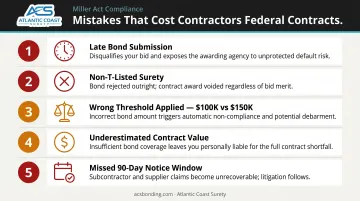
Most Common Compliance Mistakes
These are the errors that cost contractors federal contracts:
- Submitting bonds after contract award — bonds must be in place before award, not after the fact
- Using a non-T-listed surety — GAO has treated this as a non-correctable bid defect; the bond is void for compliance purposes
- Applying the wrong threshold — the base statutory figure is not what contracting officers use; the operative threshold is set by FAR
- Underestimating contract value — bond coverage must match the full contract value unless a contracting officer makes a written determination otherwise
- Missing the 90-day notice window — second-tier subcontractors who don't track this deadline lose their payment bond rights permanently
Frequently Asked Questions
What is a Miller Act bond?
A Miller Act bond is actually two surety instruments: a performance bond and a payment bond. Prime contractors must obtain both before beginning work on federal construction, alteration, or repair contracts exceeding the FAR threshold, and both are required simultaneously as a condition of contract award.
What are the requirements to be bondable?
Sureties evaluate financial strength (working capital, balance sheet), credit history, relevant project experience, and current backlog relative to bonding capacity. Contractors improve bondability by maintaining clean, CPA-prepared financials, avoiding litigation and payment disputes, and establishing a relationship with a surety agent well before bid season.
How much does a performance bond cost?
Bond premiums are calculated as a percentage of the contract amount. NASBP reports that rates vary based on contractor qualifications. Bonds below Miller Act thresholds would apply to other contract or license requirements instead.
What is the difference between a performance bond and a payment bond under the Miller Act?
The performance bond protects the federal government if the contractor fails to complete the project. The payment bond protects subcontractors and material suppliers from nonpayment. Both are typically set at the full contract value.
Does the Miller Act apply to subcontractors?
Subcontractors are not required to post their own Miller Act bonds. However, first- and second-tier subcontractors are protected by the prime contractor's payment bond and can file claims against it if unpaid. Protection does not extend to third-tier parties or below.
What happens if a contractor fails to obtain Miller Act bonds?
Failure to furnish required bonds before contract award can result in bid rejection or contract termination. The contracting officer may find the submission nonresponsive, and GAO precedent treats a missing or defective bond as a non-correctable error — not a minor irregularity that can be remedied after bid opening.