
Introduction
Picture this: a subcontractor wraps up four months of electrical work on a commercial building, submits the final invoice, and waits. Then waits some more. The general contractor has stopped making payments — and there's no clear path to recovery.
This is exactly the scenario a labor and material payment bond is designed to prevent.
The bond guarantees that subcontractors and material suppliers will be paid for work completed and materials supplied on a bonded construction project, even if the general contractor defaults. On federal public projects, the payment bond is required by the Miller Act; many states have parallel "Little Miller Act" statutes that extend the same protection to state-funded work.
This guide covers what the bond is, who it protects, when it's required, how to file a claim, and what it costs — whether you're a contractor, subcontractor, or project owner.
Key Takeaways
- A labor and material payment bond guarantees payment to subcontractors and suppliers on a bonded project — up to the bond's face amount
- It's a three-party agreement between the contractor (principal), the project owner (obligee), and the surety company
- Payment bonds are mandatory on U.S. federal contracts exceeding the Miller Act threshold — every state has a parallel "Little Miller Act" for public projects
- Subcontractors with a direct contract with the bonded GC are the primary claimants
- Deadlines are strict — missing the filing window can permanently forfeit your right to claim
What Is a Labour and Material Payment Bond and How Does It Work?
A labour and material payment bond is a legally binding guarantee that the bonded contractor will pay all subcontractors, trade contractors, and material suppliers for work and materials provided on the project — up to the bond's face amount (called the penal sum).
The Three-Party Structure
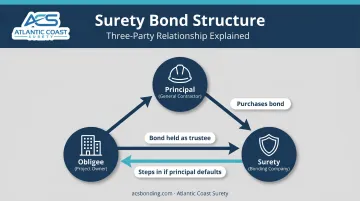
Every surety bond involves three parties:
- Principal — the general contractor who purchases the bond
- Obligee — the project owner named on the bond, who holds it as trustee for claimants
- Surety — the bonding company that steps in if the principal fails to pay
This structure matters because the surety doesn't simply absorb losses the way an insurer might. As NASBP explains, sureties underwrite with the expectation of no loss and retain the right to seek reimbursement from the contractor through a General Agreement of Indemnity. The bond underwrites the contractor's obligation — not the surety's risk.
How the Bond Is Issued
Payment bonds are almost universally issued as companion documents to performance bonds. The AIA A312-2010 form, for example, combines both bonds and is customarily issued together. A surety that qualifies a contractor for a performance bond will typically issue the payment bond alongside it, and will rarely issue a payment bond on a standalone basis.
Bond Amounts
Understanding the bond's financial scope is just as important as understanding how it's issued. Key rules to know:
- Federal standard: FAR 28.102-2 requires the payment bond to equal the full original contract price, plus any subsequent price increases
- Private and state projects: Requirements vary, but the full contract amount remains the common benchmark
- Liability cap: The surety's total liability cannot exceed the bond's face amount — payments to one claimant reduce what's available to others
Who Does a Labour and Material Payment Bond Protect?
Subcontractors and Suppliers
Trade contractors and material suppliers with a direct contract with the bonded general contractor are the primary claimants. They can file a claim against the bond directly — no need to route the dispute through the project owner.
One exception applies to lower-tier sub-subcontractors: their claim rights vary by bond form and jurisdiction. AIA A312-2010 covers claimants with a direct contract with either the contractor or a subcontractor, but Miller Act protections for second-tier claimants come with specific notice requirements (covered in the claims section).
Project Owners
The owner is named on the bond as obligee but isn't a direct financial beneficiary. The protection is indirect — and still valuable:
- Paid subcontractors have no reason to file mechanics' liens, which can cloud property title
- Reduces the owner's administrative burden in managing unpaid trade disputes
- Helps maintain project team continuity if the GC defaults
General Contractors
For GCs, a payment bond delivers advantages beyond satisfying a contract requirement:
- Demonstrates payment reliability to trade contractors, who factor this into their bids
- Encourages more competitive subcontractor pricing, since payment risk is reduced
- Maintains a clean surety relationship, preserving bonding capacity for future projects
When Is a Labour and Material Payment Bond Required?
U.S. Federal Projects — Miller Act
Under the federal Miller Act (40 U.S.C. § 3131), payment bonds are mandatory for federal construction contracts. The thresholds under FAR 28.102-1:
| Contract Value | Requirement |
|---|---|
| Contracts exceeding the Miller Act threshold | Performance bond + payment bond required (equal to the full contract price) |
| Contracts between the lower and upper thresholds | Alternative payment protection required (payment bond is one permitted option) |
| Contracts at or below the lower threshold | No bond required |
State and Municipal Projects — Little Miller Acts
All U.S. states have enacted their own versions of the Miller Act. Thresholds and bond amounts vary significantly by state:
| State | Threshold | Bond Amount |
|---|---|---|
| California | Above the state threshold | Not less than the full contract amount |
| Texas | Above the state threshold | Full contract amount |
| Florida | Above the state threshold (local governments may have exemptions) | Generally equal to contract price |
| New York | Varies by agency and contract type | Prompt payment guarantee required |
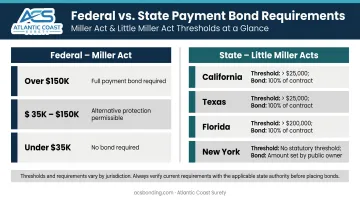
Contractors should verify the specific requirements in their project's jurisdiction — the NASBP publishes periodic state-by-state surveys of bond thresholds that serve as a reliable starting point for jurisdiction-specific research.
Private Projects
There is no federal or state mandate requiring bonds on private construction projects. Even so, private owners and construction lenders increasingly require them on larger commercial developments. Two distinct motivations drive this:
- Lenders require payment bonds to guard against mechanics' liens that could cloud title or disrupt financing
- Owners require them to ensure subcontractors and suppliers are paid — reducing the risk of project delays, lien disputes, and cost overruns
How to File a Claim Under a Labour and Material Payment Bond
Missing a filing deadline permanently forfeits your right to claim, no matter how valid the underlying dispute. Deadlines vary by bond form and project type — review them before payment problems start.
Step 1 — Know Your Deadline
Claim deadlines depend on the bond form and project type:
- Miller Act (second-tier claimants): Must give written notice within 90 days of last furnishing labor or materials — not 120 days. Direct claimants (those with a direct contract with the prime) may bring a civil action directly.
- AIA A312-2010: Written notice of non-payment required within 90 days of last performance or material delivery for claimants without a direct contractor relationship.
- Litigation deadline: Under both the Miller Act and AIA A312-2010, any civil action must be filed within one year of the last day labor or materials were supplied.
Step 2 — Prepare and Send the Notice
The notice of claim must be delivered to the right parties. Under the Miller Act, notice can be served by any means providing written, third-party verification of delivery. Under AIA A312-2010, notices must be mailed or delivered to the address on the bond signature page.
Your notice should clearly state:
- Your identity and contact information
- The project name and location
- The outstanding amount owed (with applicable taxes)
- The name of the party to whom labor or materials were furnished
- The basis for the claim
Step 3 — Gather Supporting Documentation
A strong claim file typically includes:
- Copy of your written contract with the GC (or subcontractor, if applicable)
- All invoices issued
- Proof of payments received to date
- Precise calculation of the outstanding balance
- A copy of the labor and material payment bond itself
Step 4 — Surety Review
The surety reviews your submission, may investigate project circumstances, and is generally required to deliver its position within a defined timeframe. Any undisputed amounts should be paid promptly.
Step 5 — Litigation
If the claim is disputed and unresolved, you must initiate formal legal action before the one-year deadline. At this stage, consult a surety bond attorney.
One practical step: Request a copy of the payment bond when your subcontract is awarded. Note the surety's contact information and review the bond's specific claim requirements well before any payment dispute arises.
How Much Does a Labour and Material Payment Bond Cost?
Premium Rates
Contract bond premiums are calculated as a percentage of the contract amount, based on underwriting factors. Atlantic Coast Surety offers competitive rates through A-rated and T-listed providers. Payment bonds are commonly issued with performance bonds at no additional charge, so the premium covers both bonds together.
What Affects Your Rate
Sureties evaluate several factors when pricing a bond:
- Financial strength — working capital, net worth, and overall balance sheet health
- Credit history — both corporate and personal
- Project experience — track record on similar projects
- Work in progress — current bonded and unbonded work backlog
- Bank relationships — lines of credit and banking history
- Project size and complexity — larger or more complex projects carry more scrutiny
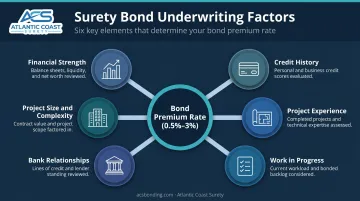
Contractors with clean surety histories and strong financials qualify for the lower end of the rate range. Newer contractors or those with weaker balance sheets typically pay higher premiums.
Working with a Surety Bond Agency
Payment bonds are obtained through licensed surety bond agencies, not directly from insurance carriers. For retail agents and brokers placing contract surety bonds on behalf of their clients, working with a wholesale specialist matters: it affects both the pricing available and the range of markets you can reach.
Atlantic Coast Surety, a bond-only wholesale agency with over 20 years of experience, places contract surety bonds through A-rated, T-listed providers. In-house underwriting authority — built through carrier relationships spanning two decades — means faster approvals and access to both standard and specialty markets.
For retail agents placing payment bonds on behalf of contractors, that direct market access translates to more competitive pricing and fewer delays at submission.
Frequently Asked Questions
What is a labour and material payment bond?
A labour and material payment bond is a surety bond that guarantees subcontractors and material suppliers will be paid for work and materials provided on a construction project. It's issued by a surety on behalf of the general contractor for the benefit of the project owner and eligible claimants.
How much does a labour and material payment bond cost?
The premium is a percentage of the contract amount based on underwriting factors. When issued alongside a performance bond, which is standard practice, the payment bond typically carries no additional premium charge. Exact cost depends on the contractor's financial strength, project size, and bond amount required.
Who can make a claim under a labour and material payment bond?
Claimants are typically trade contractors and material suppliers with a direct contract with the bonded general contractor. Lower-tier subcontractors may have claim rights as well, but those rights differ by bond form and jurisdiction, and often come with additional notice requirements.
Is a payment bond required on all construction projects?
On U.S. federal contracts exceeding the Miller Act threshold, payment bonds are mandatory. All states have Little Miller Act requirements for public contracts, with varying thresholds. On private projects, there's no legislative mandate — but owners and lenders increasingly require them contractually.
Can a surety issue a payment bond without a performance bond?
Generally, no. Sureties treat the payment bond as a companion to the performance bond and will not issue one as a standalone obligation. A contractor who qualifies for the performance bond will typically receive the payment bond alongside it.
What happens if a subcontractor misses the claim filing deadline?
Missing the applicable notice deadline typically forfeits the right to make a claim entirely: 90 days under the Miller Act for second-tier claimants, and 90 days under AIA A312-2010 for claimants without a direct contractor relationship. Monitor payment timelines closely and act quickly if payments slow down.