There's no universal minimum score published by any industry association. Individual carriers set their own thresholds, and those thresholds shift depending on bond type, bond amount, and how much financial risk the surety is taking on. What exists are broadly observed benchmarks — and knowing them helps you understand where you stand before you apply.
This article covers why credit is evaluated, what score ranges typically correspond to which markets, what happens if your credit falls short, and which other factors underwriters weigh in the final decision.
Key Takeaways
- Most standard surety markets look for a personal credit score of 650–700 or higher for preferred rates
- Scores below 650 won't automatically disqualify you — specialty markets can place higher-risk applicants, typically at higher premiums or with collateral requirements
- Credit score is just one factor; bond type, bond amount, financial statements, and work history all influence approval
- Small commercial bonds below the standard underwriting threshold often run through simplified or instant-issue programs with less stringent review
- Working with an agency that accesses both standard and specialty markets improves placement odds for applicants across all credit profiles
Why Surety Companies Check Your Credit Score
Your credit score matters because surety bonds aren't insurance — they're a financial guarantee with a repayment obligation attached. A surety bond involves three parties: you (the principal), the obligee requiring the bond, and the surety company backing your performance. If a claim is paid, the surety doesn't absorb that loss. It comes after you for reimbursement under a General Indemnity Agreement.
That reimbursement relationship is why personal credit matters. As Merchants Bonding explains, surety companies assess personal credit to evaluate how likely a principal is to repay the surety if a claim arises. Strong credit signals that you consistently meet financial obligations. Poor credit raises the probability you won't — which raises the surety's exposure.
Credit's Role Varies by Bond Size
Not every bond triggers the same level of credit scrutiny:
- Smaller bonds — Many compliance license and permit bonds at the standard threshold are instant-issue, meaning the application and credit profile alone drive the decision
- Mid-range bonds — Carriers underwrite these with an application and adequate credit score, without requiring full financial statements
- Larger bonds — Full financial underwriting kicks in: balance sheets, income statements, working capital, and cash flow all factor in alongside credit
At Atlantic Coast Surety, contractor compliance bonds above the applicable threshold specifically trigger a credit check, with authorization to pull corporate and personal credit reports for underwriting purposes. Smaller bonds in that category may not require one at all.
Credit is most decisive for smaller, simpler bonds. Once bond size and complexity increase, underwriters shift attention to full financial statements — and credit becomes one factor among several rather than the deciding one.
Credit Score Benchmarks for Surety Bond Approval
No industry association — not SFAA, not NASBP — publishes universal credit score tiers for surety approval. Carriers set their own internal thresholds, and those aren't publicly disclosed. What the market broadly reflects, based on how carriers segment applicants, looks like this:
| Credit Score Range | Typical Market Access | What to Expect |
|---|---|---|
| 700+ | Standard/preferred market | Best available rates, straightforward approval |
| 650–699 | Standard market | Likely approved, moderate premium |
| 600–649 | Standard or specialty | May need specialty market, additional documentation |
| Below 600 | Non-standard/specialty | Higher premium, possible collateral or co-indemnitor |
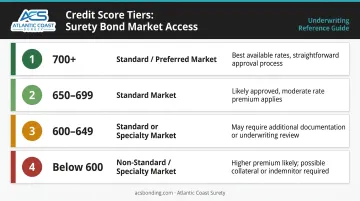
These are benchmarks, not guarantees. The same applicant can be approved by one carrier and declined by another — which is why working with a broker who accesses multiple A-rated, T-listed carriers can change the outcome.
How Bond Type Affects the Credit Bar
That carrier variance also runs across bond types. Credit requirements aren't uniform:
- Contractor license and small commercial bonds — Credit score is the dominant factor; many are approved through simplified programs without financial statements
- Performance and payment bonds — Credit can carry the underwriting for bonds up to a certain threshold; above that, full financial review is required
- Court, probate, and fiduciary bonds — Credit is evaluated, but the risk profile is specific to the obligation; Merchants Bonding identifies these as bond types where credit evaluation matters
- Financial guarantee bonds — Typically require both a credit check and financial statements regardless of amount
One consistent rule: as the bond amount grows, credit alone becomes insufficient. A contractor applying for a larger performance bond still needs to show working capital, net worth, and the capacity to complete the work.
What Happens When Your Credit Score Falls Short
A below-standard credit score doesn't disqualify you from bonding — it shifts which markets and programs apply to your application.
Specialty and Non-Standard Markets
Specialty surety markets exist specifically for applicants that standard carriers won't take at preferred terms. These programs carry higher premiums than standard market rates, and often come with additional conditions.
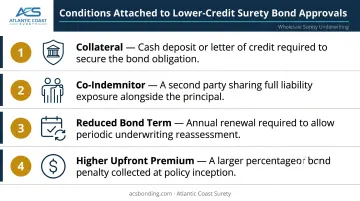
Common conditions attached to lower-credit approvals include:
- Collateral — A cash deposit or letter of credit to secure the surety's exposure
- Co-indemnitor — A second party with stronger credit who agrees to share liability under the indemnity agreement
- Reduced bond term — Annual renewal instead of a multi-year policy, allowing the surety to reassess
- Higher upfront premium — A larger percentage of the bond amount paid at inception
Bond Type Still Matters
Not every bond is equally credit-sensitive. Large public construction contracts (performance and payment bonds on federal or state work) carry stricter standards because the financial exposure is higher and defaults are costly. A straightforward contractor license bond for a small business can often be placed even with credit in the 580–620 range, depending on the carrier and the state requirement.
Working with an agency like Atlantic Coast Surety addresses this directly. As a bond-only wholesale broker with access to both standard and specialty markets, Atlantic Coast Surety can route an application to the carrier and program that fits the applicant's actual credit profile — not just the first carrier that declines.
Other Factors Surety Underwriters Consider Beyond Credit
For larger or more complex bonds, credit score is the opening question, not the final answer. NASBP describes surety underwriting as closer to bank credit than insurance — underwriters are evaluating whether you can perform and repay, not just whether you've paid your bills on time.
What Full Financial Underwriting Examines
For contract surety bonds, Atlantic Coast Surety requests:
- CPA-prepared corporate financial statements (three years)
- Current personal financial statements from each owner
- Three months of corporate and personal bank statements
- Corporate tax returns (most recent year)
- Financial statements of affiliated companies
- Bank letter showing current credit line
- Resumes of key employees
Beyond the documents, underwriters look at working capital, net worth, current ratio, debt levels, and — for contractors — work-in-progress schedules and backlog.
When Strong Financials Offset Weak Credit
An applicant with a 640 score but clean financials, a long track record, and no prior claims can outperform someone with a 670 score who has thin working capital or recent derogatory marks. The surety is underwriting an obligation and an indemnity promise, not just a consumer credit profile.
Entity type also shapes the review. How underwriters weight each factor depends on business structure:
- Sole proprietors and small LLCs: Personal credit and personal financial statements carry the most weight
- Larger corporations: Business credit history and separate business financials take on greater significance in the analysis
Steps to Strengthen Your Credit Before Applying
If your score is borderline, a few focused actions can lift your score noticeably before you apply.
Address the Two Biggest Factors First
According to myFICO, FICO scores weight factors as follows:
- Payment history — The single largest factor. Missed or late payments cause the most damage and take the longest to recover from
- Amounts owed (credit utilization) — High balances on revolving accounts suppress scores even when accounts are current
Paying down revolving balances is the fastest action most applicants can take. Because lenders typically report balances from your most recent monthly statement, a paydown can reflect in your score within one to two billing cycles.
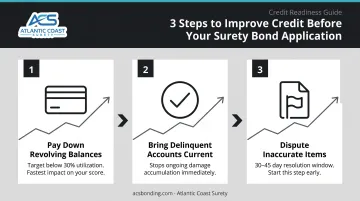
Three Actions That Move the Needle
- Pay down revolving balances — Reducing utilization on each card and overall is the fastest-impact action available
- Bring delinquent accounts current — Resolving open delinquencies stops ongoing damage; the account's history remains, but the active negative stops accumulating
- Dispute inaccurate items — The CFPB notes credit reporting companies generally have 30 days to investigate disputes (up to 45 in certain cases), so start this process well before your application
What to Avoid Before Applying
- Don't open new credit accounts in the months before applying — new credit accounts signal financial stress to underwriters
- Don't make unnecessary large credit applications — hard inquiries can lower your score by a few points and remain on your report for two years, though FICO only counts inquiries from the last 12 months
Score improvement timelines vary based on the severity of existing negative items. Applicants who address utilization and delinquencies typically see measurable gains within three to six months — enough time to shift from a borderline score to a cleaner application profile.
Frequently Asked Questions
What credit score do you need to qualify for a bond?
Most standard surety markets look for a personal credit score in the 650–700 range or higher, but the exact threshold varies by bond type, bond amount, and individual carrier. Specialty markets exist for applicants with lower scores, typically at higher premiums or with additional conditions like collateral.
What is the biggest killer of credit scores?
Payment history carries the most weight in your FICO score — meaning missed or late payments cause the most lasting damage. High credit utilization (the percentage of revolving credit you're using) is the second-biggest factor and can suppress scores even when all accounts are in good standing.
Can you get a surety bond with bad credit?
Yes — bad credit doesn't automatically disqualify an applicant. Specialty surety programs are designed for lower-credit profiles and can often place bonds that standard carriers decline. Terms typically involve higher premiums, collateral requirements, or a co-indemnitor with stronger credit.
Does applying for a surety bond hurt your credit score?
Small commercial bonds often use a soft credit pull, which has no effect on your score. Larger bonds requiring full financial underwriting may involve a hard inquiry, which can lower your score by a few points temporarily. Ask your bond producer or carrier which type of pull applies before submitting your application.
How long does it take to improve a credit score for bond approval?
Paying down balances can show visible improvement within one to three billing cycles; dispute resolutions typically take 30–45 days to process. Timelines vary — the more severe the negative items, the longer meaningful recovery takes.
Do surety companies look at personal or business credit?
For smaller bonds and sole proprietors or small LLCs, personal credit is the primary factor. Larger bond amounts and contract bonds typically require full financial underwriting, where both personal and business credit history are reviewed.